Finding Academic Papers for a Research Library

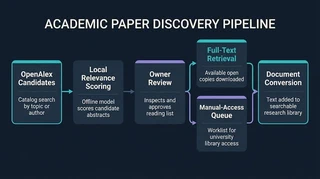 Illustration: Paper candidates move through scoring, review, access, and conversion.
Starting a literature review often means finding candidate papers, deciding which ones matter, and tracking down the full text. I built the Journal Discovery Pipeline to help organize those steps and add selected papers to a searchable research library.
The tool starts with a researcher or a topic, then finds candidate papers through OpenAlex, a catalog of academic publications. A model on my computer turns my research description and candidate abstracts into text embeddings: numerical representations used to compare meaning. Comparing those representations gives each candidate a relevance score before any download begins. This scoring stage makes no paid AI calls.
The library can also become a starting point for discovery. The tool follows citations forward to find newer papers that cite work I’ve already collected, scores those candidates, and proposes a reading list. I review that list before anything is downloaded.
For full text, the tool tries several services for freely available copies in turn, so one service missing a paper does not end the search. It can also try my university’s library access where that is available. If those routes fail, the paper goes on a list for me to open through my usual library login. In an early trial, the automatic route obtained 3 of 19 papers; the rest needed a person to retrieve them.
After the papers are available, separate conversion and search tools add their text to the research library. I can then search the papers alongside course materials, with access to more than their abstracts.
Update, October 15, 2026: A later trial searched for papers about disaster resilience, response, and recovery. Fifteen candidates passed the relevance filter, and a review found all fifteen on topic. Seven downloaded automatically; the other eight were left for manual access. That is a useful distinction in practice: finding a relevant paper and obtaining its full text are separate steps.
The project page describes the search sources, results, and remaining work.
