Indexing and Querying Academic Hub

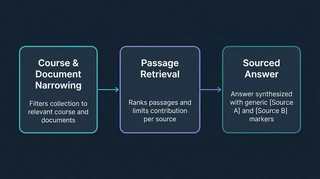 Illustration: Course and document narrowing leads to passage retrieval and a sourced answer.
Once books and notes have been converted to text, the next challenge is finding the right material and showing where an answer came from. The Source Indexer organizes the documents; RAG Analysis searches their passages to help answer questions.
The indexer creates a record for each document and groups related material by course. Search first narrows the collection to likely courses and documents, then ranks passages within them. A book can be relevant to a topic overall while only a few paragraphs contain the explanation a question needs.
The answering tool also limits how many passages each file can contribute. That helps keep one highly relevant textbook from crowding lecture notes and other sources out of the material used to write the answer.
In a recorded trial, it combined passages from two sources to answer a question about the spectral theorem, with references back to the material it used. When the collection does not support an answer, the system is intended to make that gap visible instead of dressing up a guess as a sourced result.
An illustrative source reference is Section 7.4, pages 264–266. That tells me which part of a source to open when I want to check an explanation or read further. A reference makes the reasoning easier to inspect; it does not guarantee that the answer interpreted the passage correctly.
This was an early milestone in the project. Since then, the work has expanded to include tutoring hints, answer checking, and more links between related notes. The project pages describe the current behavior, testing, and limitations; this update records the initial step from converted documents to searchable, referenced answers.
