Multi-Agent Development Workflow
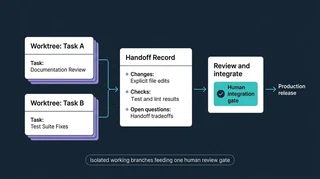 Illustration: Separate the edits, then review how the changes fit together.
For a website revision, I can give an agent the editorial guide and a set of pages, then review the resulting changes before publishing. That work happens in its own working copy, so another task can proceed without sharing the same files. The handoff carries the branch, changes, checks, and remaining questions.
Git calls these separate working copies worktrees. Each writing task gets one branch and one writer; a designated integrator combines finished changes. The files and staging areas are separate, but Git’s underlying history and branch references are shared. Isolation reduces accidental overwrites while leaving conflicts and incompatible changes for review.
The workspace’s routing guide assigns defaults by task. Claude handles architecture and decisions that depend on earlier context. Gemini handles pipeline operation, documentation, writing, and large source reviews. Codex handles routine code maintenance, tests, and Git mechanics. An explicit assignment can override those defaults—as it does when I ask Codex to revise these pages.
The routing instructions live in one shared document, linked from each agent’s entry file. That avoids maintaining three copies that can drift apart. Continuity comes from the context and records supplied in this workspace; it should not be assumed to be automatic or shared between products.
A completed task still needs integration approval. Its handoff identifies what was changed, what was checked, and what remains uncertain. A passing test suite does not establish that two independently sensible changes will work well together.
This remains a convention the participants must follow. Worktrees do not isolate a shared notes vault, an external service, or a sync process. The routing guide and worktree procedure describe the boundaries and approval rules.
