Guided Solutions
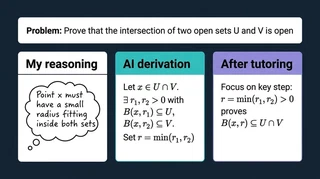 Illustration: three contributions to a solution, with their authorship kept visible.
Guided Solutions brings three contributions to a problem set together: an AI-written derivation, space for my own intuition, and a proof developed through tutoring. Each has its own labelled block, so I can compare approaches and see whose reasoning I am reading.
The separation matters when the routes differ. In the recorded microeconomics run, the agent supplied detailed reference proofs; later tutoring on two questions produced more compact proofs following the student’s approach. Both were kept, with room for the student’s interpretation alongside them.
An illustrative layout, rather than an excerpt from the private coursework, looks like this:
My reasoning: I think adding another option changes the chance of choosing the default, but I need to identify why.
Agent derivation: Work through the choice probabilities under the question’s stated rule, showing the intermediate steps.
After tutoring: Record the proof developed during the discussion and compare its key step with the reference derivation.
To prepare a document, I use the assignment and a question-by-question hints sheet to organize the work. The transcription tools make lecture notes available to the Source Indexer, which finds the course’s definitions and notation alongside textbook passages. The agent is instructed to show its algebra and assumptions, while leaving the student’s writing intact. A later audit checks the document’s structure and mathematical work.
This is a procedure I direct using the existing conversion, search, and tutoring tools. The run audit and workflow records one completed problem-set run and its tutoring follow-up. It provides a playbook for another assignment; each new solution still needs review. The course documents remain private, and the workflow has no dedicated automated test suite.
