Project Steering
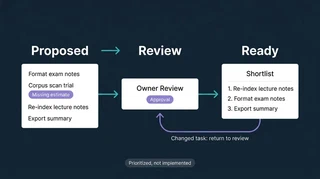 Illustration: a shortlist built from decisions I have reviewed.
Project Steering helps me choose the next task from a long project list. I review each task’s impact, urgency, effort, and dependencies; the tool uses those decisions to produce an explained shortlist. Tasks that still need estimates stay visible in a separate queue.
Each task keeps its identity when it moves within the list, but suggestions are tied to its wording. If the description changes after an AI agent proposes an estimate or assignment, that proposal becomes stale and needs a fresh review. That keeps an old suggestion from being approved for changed work.
The review page also lets me hold a task until a chosen date without changing its priority score. Reviewing Corpus Health’s daily-scan trial, for example, can remain important while staying out of today’s shortlist until the trial finishes. Suggested assignments to coding agents have their own approval step, separate from priority estimates.
Scanning the list makes no AI or network calls and does not edit the source tracker. AI-generated estimates and assignments can be imported for review, but the software never treats them as approved decisions. Choosing or ranking a task does not start its implementation.
An October 10, 2026 scan accounted for 69 active tasks with no unresolved parsing warnings. That establishes coverage of that list, while the quality of the priorities still depends on the estimates and decisions I supply. Many estimates remained unfinished at that checkpoint. Scans currently run on demand; unattended scheduling is still planned. The status record and README describe the current review rules.
