AI Research Assistant
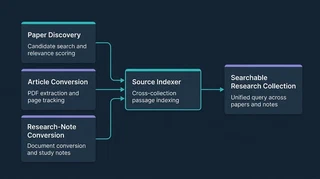 Illustration: Research workflows feed a shared index and searchable collection.
AI Research Assistant brings paper discovery, document conversion, and search into the same research workflow. It can compare candidate abstracts with a description of my research question before trying to obtain the full articles. Converted papers can then be searched alongside my own research notes using the tools developed for Academic Hub.
For an illustrative research question such as “How do researchers measure displacement after a disaster?”, the starting point is more specific than a keyword search for disasters. I can ask the discovery tool to favor empirical measurement over policy commentary, then inspect the candidates before building a reading collection.
The three current tools handle different parts of that work:
- Find candidate papers. Search an academic-publication catalog by researcher or topic, then score abstracts against the research description using a model running locally. The tool tries several sources for full text and records papers that need manual retrieval. Finding a relevant paper does not guarantee access to it.
- Make articles searchable. Convert available PDFs to text with references back to their pages. The converter reuses the course-notes tools, choosing local extraction or AI transcription according to the document. Equations, figures, and imperfect extraction still need checking.
- Bring in research notes. Convert Word documents, including research ideas and application essays, while retaining headings and basic formatting. Their text and the papers enter the same search catalog, making it possible to look for a topic across both.
The shared Source Indexer can query the research collection and Academic Hub’s course materials together. RAG Analysis can use those retrieved passages for an answer with source references. Each collection keeps its own records, so a paper, my research note, and a lecture explanation remain distinguishable when they match the same question.
These tools support a literature review that I direct: choosing the question, reviewing papers, obtaining restricted articles, and interpreting the evidence remain part of my work. The subproject pages give the current capabilities and limits of each stage.
