reprokit
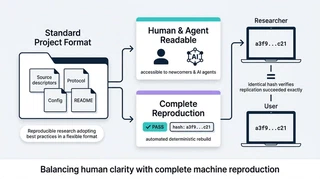 Illustration: A standard project format brings source records, readable instructions, and automated checks together.
A result is only worth as much as someone else’s ability to get it again. reprokit is the scaffolding I use to make that possible: a fixed way to describe sources, their reuse terms, and how they were checked, plus a command that tells a newcomer whether their setup works.
The problem
Research projects usually fail to reproduce for ordinary reasons. The data source was never recorded, or its terms of use were not checked. A step depended on a file that existed only on one laptop. The instructions assumed the reader already knew what a terminal was. And when something does break, the message is written for the person who wrote the code.
I started building it while working on my compound shocks panel, which combines several sources with different formats and rules. That project needed proof that its outputs rebuild exactly. I wanted that proof to be reusable, so the next project starts with it instead of adding it at the end.
What I built
- Source descriptors. A structured record for each dataset: provider, variables and units, place and time coverage, how access works, reuse terms, and how far the data has been verified. A validator checks that the record is complete and consistent with the project’s settings, and that a claim like “verified on real data” has a matching verification note.
- Evidence projects. A second project kind for literature and desk research keeps a source manifest and checks citations against included, verified sources.
verify-sourceschecks DOI and OpenAlex identifiers online;migrate-reviewconverts an older literature review into a draft manifest for screening. reprokit validate. One command that checks all of a project’s records and prints a plain explanation for anything missing. It can also warn when a source needs an account but the README does not say how to get the data by hand.reprokit quick-check. A short self-test on made-up data. It reports PASS or FAIL in ordinary language, with the next command to type, and tells the reader that it does not test the real data.- Run summaries. A project can write a readable file listing the rows produced, recorded time and memory per step, and checksums for its outputs, so two people can compare their results by comparing fingerprints.
- A project template. A repository generated with a README for non-developers (what a terminal is, what each file is for, what to do when the check fails), a protocol document, a test setup, automated checks on Linux and Windows, and a scan for accidentally committed secrets.
- Small guards learned the hard way. A loader for a project’s
.envfile for account keys (values are never printed), and a Git setting that stops Windows from rewriting line endings in data files and silently changing their checksums.
How well it works so far
- It is in real use. The compound shocks panel is built on it. Both of that project’s full rebuilds, run on 2026-11-06, finished with every checksum matching the earlier recorded run. Two more projects are in progress: Bangladesh Insurance Replication and Evidence Map; neither has reported research results here.
- Automated checks. All 431 automated tests pass locally, and continuous integration is configured for Linux and Windows.
- Clearer first steps. The generated README now explains that commands go in a terminal and names the files a newcomer will meet. Windows testing found the line-ending checksum bug above, which shipped as a fix in the next release.
- Honest limits. The compound shocks panel is the documented real-data use so far. The memory figure in its run summary counts only the main process, so it understates heavy steps. The checks confirm that a record is complete and consistent, not that its contents are true. Older projects need a manual update to receive new template text.
Releases so far are tagged v0.1.0 through v0.4.0 on GitHub.
What comes next
- Try it in the two in-progress projects and see what breaks beyond the compound shocks panel.
- Measure memory properly and say plainly what the number covers.
- Make adoption easier for an existing repository, including a clear note on how to generate a project from a local copy and how to repair line endings in older checkouts.
- Migrate remaining records to the current descriptor format so the stricter checks run everywhere.
- Keep reviewing it with fresh eyes, especially the first ten minutes for a reader who has never opened a terminal.
