Research Notes Conversion
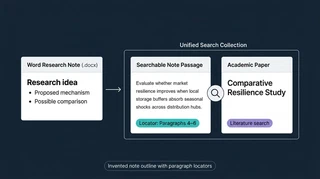 Illustration: Find a research idea again, with a reference to its place in the note.
An old research idea is easier to revisit when I can find it beside the papers that discuss the same topic. Research Notes Conversion brings Word essays and research notes into that search collection. It reads the document’s existing headings and formatting directly, so the conversion itself needs neither image recognition nor an AI model.
Finding a passage also needs a useful locator. Word documents do not carry the PDF page markers the search tools originally expected. The indexer now uses headings where available and paragraph numbers as a fallback, so a short note can be cited without inventing a page number.
For an illustrative conversion, a heading such as Research idea and its following paragraphs become a heading and ordinary text in the searchable version. A reference such as Paragraphs 4–6 tells me where to look within that note. This demonstrates the format, not an excerpt from my private writing.
The original Word file stays in place. Conversion creates a Markdown copy, retaining headings, emphasis, and lists. Optional registration with the Source Indexer adds a catalog description and a representation used for search, using API calls; conversion alone remains local.
Reusing the course-material indexer exposed a useful mismatch: its original document labels tried to classify personal essays as textbooks or handwritten notes. Giving the research collection its own vocabulary fixed that distinction. Search also keeps each result’s collection identity, so two folders both named “notes” cannot be confused merely because their names match.
The early validation used 19 essay and research-note files. After the classification and locator fixes, topic queries could search this collection and Academic Hub together, returning relevant material from the appropriate sources. That is a limited recorded trial, not evidence that every query will find everything relevant.
The converter still works on selected local files. Direct Google Drive ingestion and a complete literature-review workflow are beyond its current interface. Journal Article Transcription adds papers to the same search infrastructure; the README documents conversion and indexing options.
