RAG Analysis
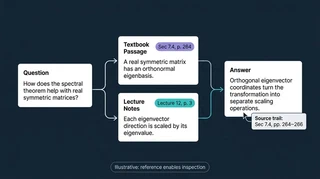 Illustration: keep an explanation connected to the passages used to write it.
RAG Analysis answers a question using passages found in my textbooks and course notes, with references back to the material it used. That lets me inspect an explanation and continue reading at its source. The reference is a starting point for checking the answer, not a guarantee that the model interpreted it correctly.
One useful choice is limiting how many passages a single file can contribute. Otherwise, a relevant textbook can fill the available space and crowd out lecture notes or another author’s explanation. Follow-up questions are also rewritten using the recent conversation, so “explain that differently” becomes a specific question the search tools can use.
A clearly illustrative example, rather than a quotation from a recorded answer:
Question: What does the spectral theorem help explain about a real symmetric matrix?
Answer sketch: It gives perpendicular directions along which the transformation acts by scaling, making its action easier to describe.
Reference format: Section 7.4, pages 264–266.
The name RAG means retrieval-augmented generation: find relevant passages first, then supply them to the model writing the answer. This project reuses the Source Indexer for that search. An August 2026 trial answered a spectral-theorem question using two source files; a follow-up exchange also exercised the conversation-based search step. Those were specific trials, not a broad evaluation of answer accuracy.
What is remembered
The running chat retains its conversation, but restarting the process does not restore the full dialogue. With a course selected, the tool can save answer, hint, draft-feedback, and verification events. Recent recorded learning gaps can inform later answers, and a session recap can turn the recorded discussion into a study note.
Requesting a report also saves the answer as a note with its source references. Those references identify the passages in the Source Indexer, so Summary Enhancement can reopen that material and develop a short answer into fuller explanations and examples. The Study Guide Pipeline offers another starting point when I already have a topic list. Saved notes and logs survive separately from the live chat history.
A companion resolver answers question markers in handwritten notes. Its recorded seven-question run included four source-grounded answers and three marked as ungrounded. General answers remain leads to check, and retrieving a handful of passages is too narrow to establish comprehensive coverage of a week’s study.
The README describes the current interfaces. Tutor Diagnosis adds feedback on an attempt; the separate Socratic Tutor manages an ongoing tutoring session.
