Notes Transcription Pipeline
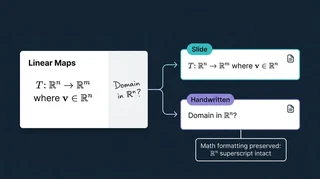 Illustration: keep the handwriting, slide text, and source trail distinct while preserving mathematical superscripts.
A question scribbled beside a lecture slide is easy to lose in a folder of drawings. Notes Transcription turns handwritten canvases and short course PDFs into searchable text, keeping references to the original material. It also separates pasted slides from handwriting, so later study tools can tell which explanation came from the lecturer and which note I added.
Typed PDFs need care too. A small raised character can carry the difference between R² and R2, yet ordinary text extraction may flatten them into the same line. The pipeline uses character size and vertical position to recover exponents and subscripts locally before deciding whether a page needs AI transcription. That preserves useful structure without paying a model to reread every clean page.
Once the output is registered with the Source Indexer, its passages can be found alongside textbook material. That is what lets the Study Guide Pipeline draw on a handwritten explanation, or Concept Graph cite course notes behind a proposed connection. Transcription prepares the material those tools read.
Choose how much of the source needs rereading
The PDF path uses three levels of work. Clean digital text can be extracted locally. If only a few pages look defective, those pages receive image-based repair with neighboring text for context. Handwriting, difficult exports, or documents with widespread defects need fuller transcription. Some note-taking exports can omit entire equation regions from their text layer, so an apparently clean extraction is insufficient evidence for trusting them.
The recorded August 2026 comparison checked recovered exponents and subscripts across 13 pages from two documents against existing transcriptions. In one 43-page problem set, the local improvements reduced the detected defect rate from 63% to 5%, leaving two pages for repair. Those results concern the checked notation and routing decisions, not the accuracy of every word in the collection.
Drawings and PDFs take different paths
Excalidraw saves its SVG images automatically. The canvas path cuts a tall drawing at whitespace gaps, transcribes the pieces with some preceding context, and produces both a raw transcript and an expanded note for search. Expansion adds prose and can introduce interpretation; the raw version and source drawing remain important for checking it. Handwritten questions can be marked for a separate answering tool.
The current command-line workflow can prepare page images and task cards for a subscription agent, then validate the submitted cards before writing the usual outputs. This is a manual handoff. The metered API path is also available, and search indexing has its own API calls; running the scripts locally does not mean all processing stays on the device.
Supported sources here are PDFs and Excalidraw scenes with exported images. Word-produced PDFs fit the PDF route; native Word documents are a separate conversion task. Most importantly, plausible-looking errors can survive transcription. Notes Post-Processing checks suspicious text against source images afterward, while the README explains the available routes.
